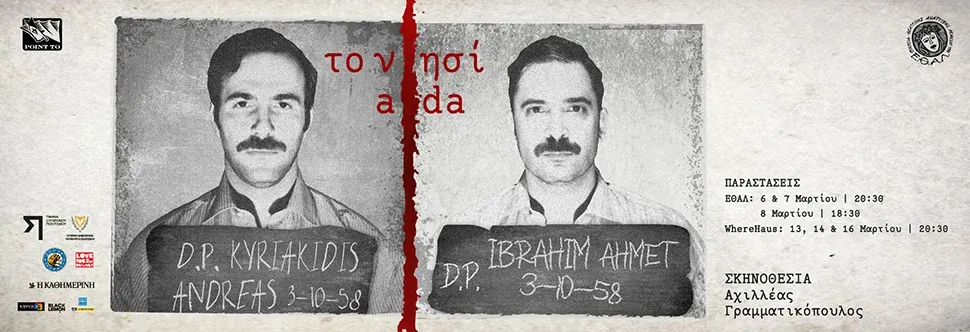
“The Island”, after a warm reception from audiences and successful performances in Limassol and Nicosia, returns for a limited number of performances at ETHAL Theatre and Wherehaus 612. An original theatrical work, product of research and fiction, based on real events and recorded testimonies, it focuses on the collective trauma of contemporary Cypriot society, highlighting the two sides of a divided identity and exposing the violence suffered by people because of their faith or origin.
With this production ETHAL, in collaboration with Point To Contemporary Theater, inaugurated its theme for the 2025-2026 theatre season centered on language, communities, communication, dialogue, multiculturalism and the collective memory of our island.
The Republic of Cyprus assuming the Presidency of the European Union served as the starting point for creating an original play that brings forward Cyprus’s history, collective memory and culture. The aim is not to give a history lesson but, through fiction, to create a theatrical space where the spectator will see – through the coexistence of two opposing voices – the possibility of reconciliation and acceptance.
The performance does not seek a “position” but observation: two bodies in a prison learning to respect each other’s silence. And through that silence something stronger than agreement is born: coexistence! The play focuses on two men who share the same cell in a prison of colonial Cyprus between 1955-1959: a Greek Cypriot fighter of EOKA and a Turkish Cypriot teacher accused of an armed attack on a policeman during a demonstration demanding partition. The two characters come from rival worlds and carry national, linguistic and ideological oppositions. Yet, through the daily life of prison, the oppression, the violence of interrogations and the silence of isolation, they confront the condition of the Other.
**The performance contains strong verbal and physical violence as well as harsh, realistic images.
Synopsis:
Andreas and Ibrahim live two very different lives, with different beliefs and backgrounds. One Greek, the other Turkish; one a farmer and the other a teacher; one Christian, the other Muslim. Their oppressors throw them into the same cell until they confess, one for an attack on a policeman and the other for a murder. Or until they kill each other. The purpose seems initially achieved, but the presence of the Other changes their story. And, as in Ancient Tragedy, the question to be answered is: whose Justice will prevail?