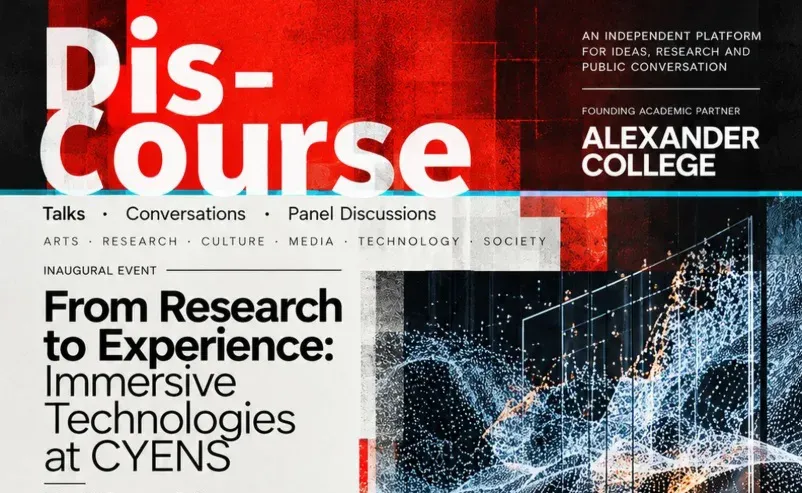
Dis-Course, an independent interdisciplinary platform for ideas, research and public discussion, is launching its new programme in November, marking a significant expansion of an initiative founded in Cyprus three years ago. Initially developed as a university lecture series, Dis-Course is now evolving into an independent platform that connects academics, researchers, artists, designers and professionals across various disciplines, institutions and geographical boundaries.
Based in Cyprus with an international perspective, it combines live events in Larnaca with online participation, live streaming and a growing digital archive, creating a space where ideas can circulate beyond the lecture hall, the conference and the single institution.
The 2026-27 programme will combine lectures, discussions and multi-perspective debates. Speakers will be invited to Larnaca, international contributors will take part online for audiences in Cyprus, and multi-perspective debates will bring together diverse viewpoints on contemporary issues spanning the arts, humanities, science, research, culture, media, technology and society.
The first event of the relaunched Dis-Course programme will take place at Alexander College, Larnaca, on Wednesday 4 November at 6 PM, with Dr Kleanthis Neokleous of the CYENS Centre of Excellence. Under the title 'From Research to Experience: Immersive Technologies at CYENS', Dr Neokleous will present the work of the CYENS Centre of Excellence, with particular emphasis on the research teams Immersive Technologies for Intelligent and Creative Applications (ITICA) and Museum Lab.
The lecture will explore how research, technological innovation, creativity and human-centred design come together in developing interactive and immersive experiences in cultural heritage, education and other fields of application. Through selected projects, Dr Neokleous will show how research ideas are translated into practical applications using technologies such as virtual and augmented reality, three-dimensional visualisation and interactive storytelling. The examples will trace the collaborative process from idea development and experimentation to implementation and real-world deployment, showing how immersive technologies can create new ways of exploring, understanding and interacting with the world around us.
Among the first announced panels is 'Who Owns the Image? Photography, Place, Memory and the Right to Represent', which brings together perspectives from photography, visual culture, art history and the built environment. The discussion will examine questions of creation and representation: who has the right to create, interpret and circulate images of people, places and stories, and how these issues change as images move between personal, institutional and increasingly computational contexts.
Another panel, 'The Possibility of Philosophy after Heidegger', will bring together philosophers to examine the continuing possibilities, problems and responsibilities of philosophical thought in the context of one of the most influential and controversial thinkers of the twentieth century.